



Personally vetted instructors
Swedish Grammar tutors, lessons & classes
Då ska vi se Då ska vi se, the way a Swedish grammar teacher opens a lesson — "let's see then."
Personally vetted Swedish tutors who teach the grammar properly. Lessons that move through the en/ett noun system, V2 word order, the definite-suffix pattern, and the modal verbs that organize how Swedish actually feels in the mouth.
Your instructors
Swedish Grammar tutors for private lessons & classes
The tutors below are the ones on our Swedish roster with the deepest grammar backgrounds. Several are native Swedes with formal training in linguistics or Swedish-as-a-foreign-language pedagogy, a few have taught at SFI or university level, and every one of them was met and vetted by Strommen directly before being listed.
Filter by location, age, or price, read the bios, then book a 30-minute free trial.
Below are the Strommen tutors who teach Swedish grammar in depth. Photos, ratings, and rates are real. Click any card to read the tutor's background and book a free 30-minute trial.
I want to learn…
Every tutor, personally met. — founder-vetted since 2006, in Los Angeles and online worldwide.
Get a personalized plan
Pick your language — a language advisor will match you with the right tutor and map out your path.




PhD, BSc
PHD with Degree in Swedish and German Linguistics - Arctic researcher, PHD in Biology offering fun and interactive Swedish and German lessons
Personally vetted · Strommen’s note
Carola is a PhD biologist and Arctic researcher with a separate degree in Swedish and German linguistics. She brings that same field rigor into lessons.
Specialties
PhD, BSc
PHD with Degree in Swedish and German Linguistics - Arctic researcher, PHD in Biology offering fun and interactive Swedish and German lessons
Specialties
Personally vetted · Strommen’s note
Carola is a PhD biologist and Arctic researcher with a separate degree in Swedish and German linguistics. She brings that same field rigor into lessons.

Grammatik — structure & rules
5 grammar anchors every Swedish learner meets
These are the structural features that shape Swedish grammar and that an Anglophone learner has to internalize to sound natural. Save the list and book a tutor to work through them in the order that fits your level.
-
01
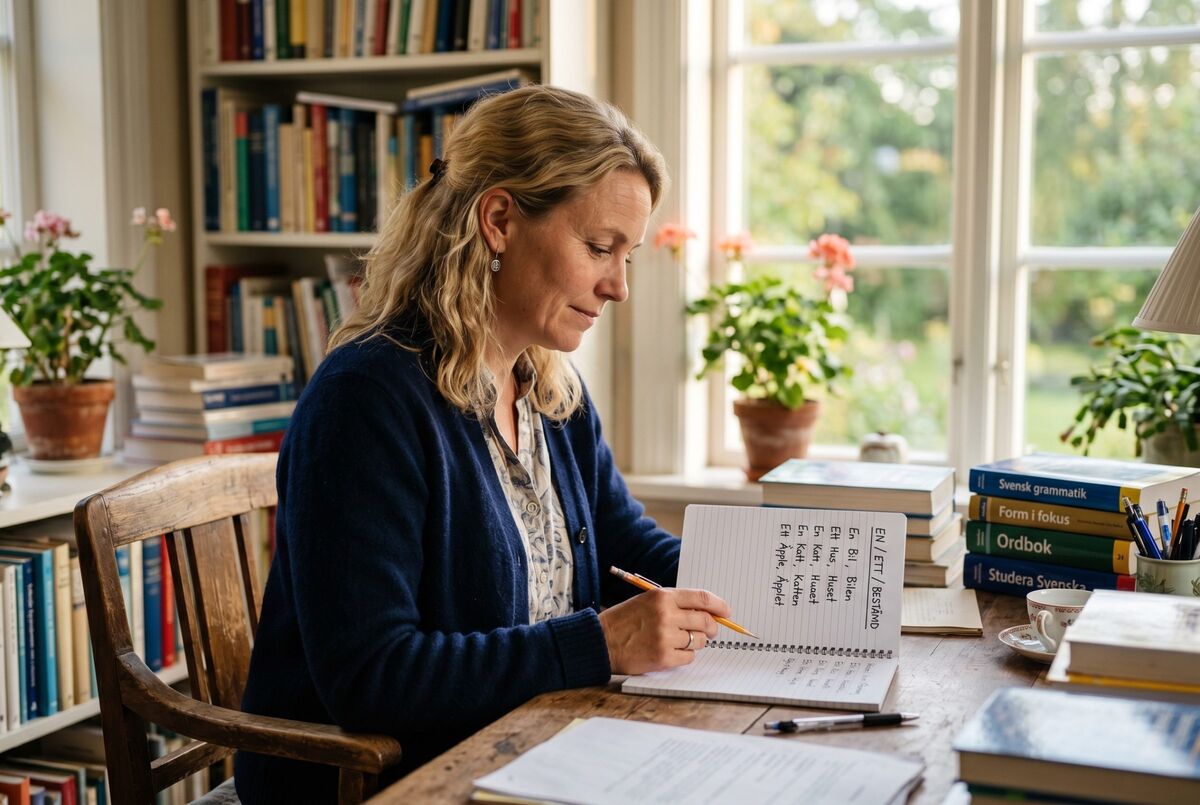
En and ett
Swedish has two noun genders, en (common) and ett (neuter), with no fully reliable rule for which is which. Roughly 75 percent of common nouns are en-words. The gender cascades through the indefinite article, the definite suffix, the adjective endings, and the pronoun used to refer back to the noun. Patterns exist (people and animals tend toward en; abstract concepts and many English borrowings tend toward ett), but vocabulary has to be learned with its gender attached.
e.g. En bil (a car), bilen (the car) vs. ett hus (a house), huset (the house).
-
02
Suffixed definite article
Where English uses a freestanding "the" in front of the noun, Swedish suffixes the article onto the noun itself. Bil becomes bilen, hus becomes huset, bilar becomes bilarna. When an adjective sits in front of a definite noun, double determination kicks in: both the freestanding article (den or det) and the suffixed article appear together. The doubling feels redundant to English speakers; it is mandatory.
e.g. Den stora bilen ("the big car") — both den and -en are required.
-
03
V2 word order
In a Swedish declarative main clause, the conjugated verb always lands in the second position, regardless of what is in first position. If a time or place phrase is fronted, the subject moves after the verb. Subordinate clauses keep subject-verb order. V2 is the single feature that makes Anglophone Swedish sound translated when it is missed and the single feature that, when mastered, makes Swedish sound Swedish.
e.g. Idag äter jag pizza (literally "today eat I pizza," not "today I eat pizza").
-
04
Ska, vill, kan, får, måste, bör
The modal-verb system that does a lot of the work English uses tense for. Swedish modals govern an infinitive without to: jag ska gå, jag vill stanna, jag kan simma, jag får komma in, jag måste arbeta. The English translations slip because Swedish modals partition the semantic space differently: ska carries intention beyond simple future, får is permission and softer obligation, vill becomes polite request in the conditional.
e.g. Jag skulle vilja ha en kaffe ("I would like a coffee," the polite-conditional modal stack).
-
05
Språkrådet
The Language Council of Sweden, the language-management arm of the Institute for Language and Folklore (Institutet för språk och folkminnen). Together with the Swedish Academy, Språkrådet publishes the authoritative dictionary (SAOL), supports the four-volume Svenska Akademiens grammatik, and issues the running guidance that defines standard Swedish. Its published advice is the reference any serious student or tutor will reach for on a disputed usage question.
e.g. Språkrådet's site is the place to settle whether a borrowed English word takes en or ett.
About Swedish Grammar
The grammar Swedish actually runs on
Swedish grammar is lighter than most learners expect on a few axes and trickier than most learners expect on a few others, and a grammar-focused tutor exists to help you spend your time on the parts that actually matter. The light parts are real: Swedish has no case system to speak of (the genitive -s is the only surviving noun ending), verbs do not conjugate for person or number (jag är, du är, vi är, de är, all the same form), and the vocabulary overlaps heavily with English because of the shared Germanic backbone. A Swedish-learning Anglophone can produce understandable sentences within weeks. The trickier parts are also real and tend to surface only once a learner gets past the beginner stage: the two noun genders (en-words and ett-words, with no fully reliable rule for which is which), the definite-article system that suffixes onto the noun itself rather than standing as a separate word, V2 word order that forces the verb into second position in declarative main clauses, and a modal-verb system (ska, vill, kan, får, måste, bör) that does a lot of the work English uses tense for.
The students who come to Strommen for grammar-focused Swedish tutoring are usually past the very-beginner stage. Some have worked through Duolingo or Babbel and have hit the wall that those apps run into around the intermediate plateau, where vocabulary keeps accumulating but grammatical precision stops improving. Some are heritage learners who grew up listening to Swedish at home and want to formalize the grammar they already half-know. Some are working through the Swedish for Immigrants (SFI) curriculum in Sweden and want extra structure beyond the classroom. Some are professionals (often academics, technologists, or healthcare workers) whose work requires written Swedish that does not embarrass them. And some are advanced learners preparing for the Swedish national TISUS test, the Test in Swedish for University Studies that determines admission to Swedish-language degree programs. A grammar tutor calibrates the lesson plan to whichever entry point fits.
The en/ett distinction is where most adult learners hit their first real grammar wall. Roughly 75 percent of Swedish common nouns are en-words and 25 percent are ett-words, and the choice cascades through everything else: the indefinite article (en bil, ett hus), the definite suffix (bilen, huset), the plural definite (bilarna, husen), the adjective endings (en stor bil, ett stort hus), and the pronoun used to refer back to the noun (den or det). The bad news is that there is no single rule that predicts gender reliably. The good news is that there are patterns: most words for people and animals are en-words, most abstract concepts and many borrowed words from English are ett-words, words ending in -ing and -het are reliably en, words ending in -ande and -ende are reliably ett. A grammar tutor introduces the patterns in a sequence that lets a student learn most of the vocabulary correctly the first time rather than memorizing gender on a word-by-word basis after the fact.
The definite-article suffix is the next real surprise. In Swedish, the definite article attaches to the noun itself: bil becomes bilen (the car), hus becomes huset (the house), bilar becomes bilarna (the cars), hus becomes husen (the houses). English speakers tend to want to put a separate word in front the way "the" works, and they tend to drop the suffix when they should keep it. The system is regular once learned, but it interacts with adjective placement in a way that creates the famous Swedish "double determination": when an adjective sits in front of a definite noun, both the freestanding article and the suffixed article appear (den stora bilen, "the big car"). The doubling feels redundant and trips learners up; a grammar tutor walks through the cases where it applies and the cases where it does not.
V2 word order is the structural feature that makes Swedish feel different from English in a way most learners cannot quite name at first. In a Swedish declarative main clause, the conjugated verb always lands in the second position, regardless of what occupies the first position. If the subject is first, the verb follows it (jag äter pizza, "I eat pizza"). If a time or place adverb is first, the verb still lands in second position, which means the subject moves after the verb (idag äter jag pizza, literally "today eat I pizza"). The same is true if an object is fronted for emphasis (pizza äter jag inte, "pizza I do not eat"). The V2 constraint applies only to main clauses; subordinate clauses keep subject-verb order. Anglophone learners produce sentences that are grammatically clean except for this one feature, and it is the single highest-leverage thing a grammar tutor can fix because it is what separates Swedish that sounds Swedish from Swedish that sounds translated.
The modal-verb system is the other place a grammar tutor earns the lesson fee. Swedish uses ska (future, intention, often translated "will" or "shall"), vill (want), kan (can, ability), får (may, permission, also "get to"), måste (must, necessity), and bör (ought to) as auxiliaries that govern an infinitive without to: jag ska gå, jag vill stanna, jag kan simma, jag får komma in, jag måste arbeta, jag bör läsa. The English translations are slippery because Swedish modals partition the semantic space differently. Ska is not just "will," it carries the speaker's intention or commitment in a way "will" does not always. Får is permission and also a softer obligation. Vill is want, but in conditional contexts (skulle vilja, "would like") it becomes polite request. Mastering the modal field is the difference between Swedish that communicates and Swedish that sounds native.
The Swedish Academy and the Swedish Language Council (Språkrådet, the language-management arm of the Institute for Language and Folklore) together do for Swedish what the Académie française does for French and the Real Academia Española does for Spanish: they publish the authoritative dictionary (SAOL, Svenska Akademiens ordlista), the descriptive grammar (Svenska Akademiens grammatik, four volumes, finalized 1999), and the running language-management guidance that defines standard Swedish. A grammar-focused tutor will draw on these references for serious questions about usage and will name them when a student asks where the rules come from. Both institutions are unusually accessible: SAOL is online and free, and Språkrådet's published guidance is the standard reference for any disputed usage question.
Strommen has been teaching languages in Los Angeles since 2006, and the Swedish grammar track sits among the more linguistically rigorous on our roster. Every tutor below was met and vetted by us in person. There is no marketplace here. Lessons run online for students worldwide and in person for those near Los Angeles, and most students begin with a free 30-minute trial so the tutor can see exactly where you sit before recommending a starting point. If your goal is conversational Swedish from scratch rather than systematic grammar, see our Swedish for Beginners page; if you are teaching Swedish to a child, our Swedish for Kids page covers that track.
What you'll cover
Lessons & classes tailored to Swedish Grammar
The en/ett system and the gender cascade
Systematic work through the two-gender system and the patterns that predict gender most of the time. Lessons sequence the major suffix patterns (-ing, -het, -dom, and the others) so a student learns most new vocabulary with the correct gender attached the first time. The cascade into the indefinite and definite articles, the adjective endings, and the pronoun system gets folded in as the vocabulary expands.
Definite-article suffixes and double determination
The full pattern of suffixed definite articles across both genders and both numbers, plus the double-determination rule when an adjective sits in front of a definite noun. Lessons cover when double determination applies (with most adjective+noun combinations) and when it does not (in some fixed phrases and in certain stylistic registers), so a student stops producing the "den bil" and "stora bilen" mistakes that mark early-intermediate Swedish.
V2 word order and the inversion rule
The V2 constraint in main clauses and the subject-verb order in subordinate clauses, taught with the kind of practice that builds the reflex rather than the conscious rule. Drills focus on fronted time adverbs (idag, igår, alltid), fronted place adverbs (här, där, hemma), and fronted objects, because those are where Anglophones default back to English word order. By the end of the unit a student is producing V2-correct sentences without thinking about it.
The modal system and tense-aspect interactions
All six modal verbs (ska, vill, kan, får, måste, bör) with their semantic ranges, their interactions with infinitives, and their conditional and perfect forms. Lessons cover how Swedish uses modals to do work English does with tense (future, conditional, polite request), and how the modal stack works (jag skulle vilja ha, jag måste ha gjort). This is the unit that takes a student from communicative Swedish to Swedish that sounds genuinely native.
FAQ
About Swedish Grammar lessons & classes
How long does it take to get Swedish grammar to a solid intermediate level?
It depends on your hours and your starting point. A motivated Anglophone with no prior Swedish doing one to two grammar-focused lessons a week with consistent self-study can usually reach a solid intermediate-grammar level in nine to twelve months. The en/ett system and V2 word order tend to be the two bottlenecks; once those become automatic, the rest of the grammar accumulates faster. Students who already speak German or Dutch tend to move faster because the Germanic family overlap is substantial.
I keep getting en and ett wrong. Is there any reliable rule?
No single rule covers everything, but there are patterns worth knowing. Most words for people and animals are en-words. Most words ending in -ing, -het, -dom, -lek, and -skap are en-words. Most words ending in -ande, -ende, and -eri are ett-words. Most abstract concepts and many borrowed words from English (especially recent tech vocabulary) are ett-words. Beyond that, vocabulary has to be learned with its gender attached. A grammar tutor introduces the suffix patterns in a deliberate sequence so most of the vocabulary you learn comes in with the right gender the first time.
What is V2 word order and why does it matter?
V2 is the rule that in a Swedish declarative main clause, the conjugated verb always sits in the second position, regardless of what is in first position. If you front a time word like idag (today) or a place word like hemma (at home), the subject has to move after the verb: idag äter jag pizza, hemma talar vi svenska. Most other features of Swedish grammar are forgiving for Anglophones because the Germanic overlap is so strong, but V2 is the one feature where English word-order instinct produces sentences that sound translated. Fixing V2 is the single highest-leverage thing a grammar tutor can do.
Should I use a textbook or just work with a tutor?
Both, and the tutor will recommend a textbook based on your level. For systematic adult grammar work, Rivstart (the standard Swedish-for-foreigners series, used by SFI programs in Sweden) is excellent and goes from A1 through B2. Form i fokus is a more grammar-focused supplement that drills paradigms and structures the way a serious learner needs. For reference, Svenska Akademiens grammatik (the four-volume descriptive grammar from the Swedish Academy) is the authoritative source, and a tutor will reach for it on disputed usage questions. Lessons make the textbook work harder than self-study with the textbook alone.
Can I prepare for the TISUS test with grammar tutoring?
Yes, and TISUS is one of the more common goals among advanced learners. The Test in Swedish for University Studies is the standardized exam Sweden uses to certify Swedish proficiency for admission to Swedish-language university programs. Tutors who have run TISUS prep know the exam's four sections (reading, writing, listening, oral interview), the level of grammatical precision the written section expects, and the topical vocabulary range the prompts typically draw from. A focused six-to-nine-month prep is usually enough for a B2-level student.
Will my German help me learn Swedish grammar?
Significantly, yes, more than for any other language pair. German and Swedish share Germanic grammar at the deepest level: V2 word order works the same way in main clauses, the modal-verb system maps closely (German kann, will, soll, muss correspond directly to Swedish kan, vill, ska, måste), the noun-gender concept is familiar even though the actual gender assignments differ, and the basic vocabulary overlap is substantial. What German does not give you is the suffixed definite article (German keeps definite articles freestanding) or the simplified verb conjugation (German still conjugates verbs for person and number, which Swedish has lost). Most German speakers find Swedish grammar noticeably easier than the average learner.
Are your Swedish grammar tutors native speakers?
Most are native Swedes, often with formal training in linguistics, Swedish-as-a-foreign-language pedagogy, or classroom teaching at SFI or university level. A few are longtime Swedish-fluent non-natives with formal Swedish grammar training, which sometimes works well for adult students because a non-native grammar tutor has consciously learned the rules a native speaker absorbed without thinking. Each tutor's bio specifies background; the trial lesson is the place to confirm the rapport and the teaching style.
Can I take Swedish grammar lessons online or only in person?
Both. Most of our Swedish grammar tutors teach online via Zoom or Jitsi and work with students worldwide. Several also teach in person around Los Angeles. Grammar-focused lessons work very well online because most of the lesson is spent on shared paradigm tables, written sentences, and texts. The booking widget on each tutor's profile shows their available formats.
Ready for Swedish Grammar lessons or classes?
Book a free 30-minute trial with one of our personally vetted tutors. Private lessons or small-group classes — your choice.