



Personally vetted instructors
Urdu for Beginners tutors, lessons & classes
السلام علیکم Beginner-formal: "peace be upon you," the universal Urdu opener used across every register.
Personally vetted Urdu tutors who teach absolute beginners. Lessons that start in spoken Urdu and Roman transliteration, then bring in the Nastaliq script on a schedule that matches your goals rather than rushing or skipping it.
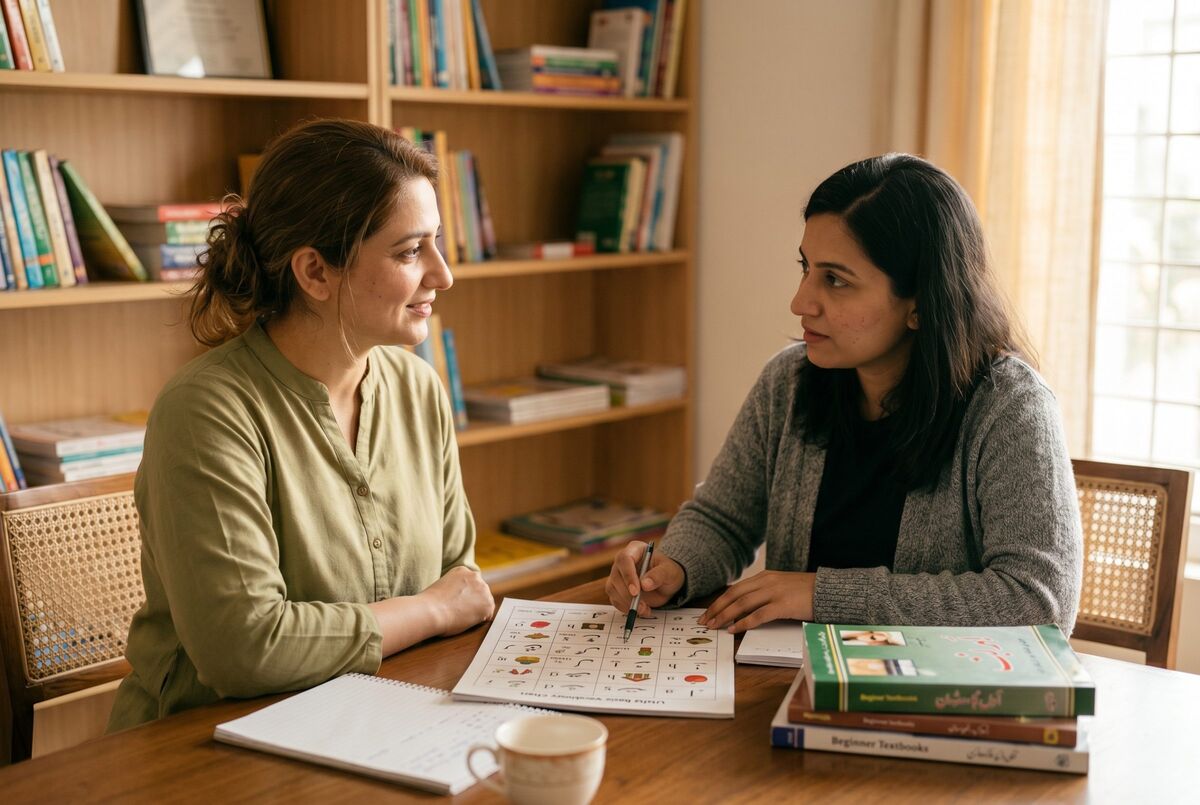
Your instructors
Urdu for Beginners tutors for private lessons & classes
Strommen has placed Urdu tutors for years. The steady ask from new students tends to be heritage — a parent or grandparent whose Urdu they want to share — or a partner or in-laws whose conversations they want to follow. Strommen is a curated practice rather than an open marketplace, so every tutor below was met and vetted by us. Their bios are real.
Filter by location, age, or price. Then book a 30-minute free trial.
Below are the Strommen tutors who teach Urdu to absolute beginners. Photos, ratings, and rates are real. Click any card to read their bio and book a free 30-minute trial.
I want to learn…
Every tutor, personally met. — founder-vetted since 2006, in Los Angeles and online worldwide.
Get a personalized plan
Pick your language — a language advisor will match you with the right tutor and map out your path.


Bachelor of arts (Hindi) · Bachelor of arts (Hindi)
Master Hindi with Ritu: Fun, Culture, and Success in Every Lesson - over 1000 classes taught
Specialties
Bachelor of arts (Hindi) · Bachelor of arts (Hindi)
Master Hindi with Ritu: Fun, Culture, and Success in Every Lesson - over 1000 classes taught
Specialties

Pehla qadam — first step
5 things to know about Urdu before lesson one
Five honest notes for a beginner, the kind a careful tutor would give you in the trial. Save the image. Send it to the family member who has been gently waiting for you to start.
-
01
You can start without the script
Nastaliq is one of the most beautiful scripts in the world and also the slowest-learned skill in beginner Urdu. Many learners begin in Roman-Urdu transliteration (the casual romanization Pakistanis use in WhatsApp every day) and add the script in month two or three. You can become fluent in spoken Urdu without ever reading Nastaliq if that fits your goals.
e.g. Aap kaise hain in Roman-Urdu is آپ کیسے ہیں in Nastaliq. Same sentence, two doors in.
-
02
Aap, tum, tu — three yous, three registers
Urdu marks respect with the pronoun. Aap is formal and the safe choice for elders, teachers, strangers, and most professional settings. Tum is friendly, used with peers and family equals. Tu is intimate or, in some contexts, can sound dismissive. Beginners are taught to default to aap until specific people warrant the shift.
e.g. Aap kahan se hain? — "Where are you from?" said respectfully to anyone new.
-
03
Verbs come at the end
Unlike English, Urdu places the verb at the end of the sentence. This is a small reorientation for the brain that becomes natural in a few weeks. Once it clicks, sentences start sounding right even when you build them slowly. The pattern repeats with such regularity that beginners often describe it as easier to internalize than English's stricter word order.
e.g. Main bazaar jaa raha hoon — literally "I market going am," meaning "I am going to the market."
-
04
Adab is built into the words
Adab is the cultural concept of refined respect, and Urdu's polite vocabulary reflects it. Insha'Allah ("God willing"), Masha'Allah ("as God has willed"), and Alhamdulillah ("praise be to God") thread through conversation regardless of how religious a speaker is. They are vocabulary, not piety. Learning to drop them naturally is part of sounding adult in Urdu.
e.g. Bachay kaise hain? — Alhamdulillah, bilkul theek hain. "How are the kids?" — "Praise be, perfectly fine."
-
05
Hindi and Urdu, two doors, one room at first
At the colloquial spoken register, Hindi and Urdu are essentially the same language with different scripts and different formal vocabularies. A beginner learning Urdu can hold an everyday conversation with someone whose family taught them Hindi, and vice versa. The languages diverge in literary and formal registers, where Urdu reaches toward Persian and Arabic, and Hindi toward Sanskrit.
e.g. Aap kaise hain (Urdu) and Aap kaise hain (Hindi) are spoken identically. The divergence is in the writing system and the formal vocabulary.
About Urdu for Beginners
Urdu that begins in your mouth, not on the page
An honest first conversation about learning Urdu starts with a choice the textbook usually avoids: how soon to bring in the script. Urdu is written in Nastaliq, a flowing right-to-left calligraphic form of the Perso-Arabic script. It is beautiful, it is several hundred years old, and for a beginner it is the part of the language most likely to derail an otherwise smooth start. So at Strommen we usually do not start there. We start with the spoken language, supported by Roman-Urdu transliteration (the casual romanization Pakistanis use every day in WhatsApp and on social media), and we add the Nastaliq script on a schedule that matches what you actually want to do with the language.
If your goal is family conversation and travel, you can become conversational in Urdu without ever learning the script, the same way many bilingual Pakistani-Americans speak fluently while reading and writing primarily in English. If your goal includes reading shayari (poetry), enjoying classic films, or working with literary text, then the script becomes essential and we structure the lessons accordingly. The honesty in lesson one is what matters. Beginners who try to do all of it on day one tend to stall.
Urdu has roughly 70 million native speakers, primarily in Pakistan, India, and a substantial South Asian diaspora across the Gulf, the UK, North America, and Australia. It is the national language of Pakistan and one of the 22 scheduled languages of India. The Hindi-Urdu spoken continuum is the underlying reality of the language: at the colloquial register Hindi and Urdu are nearly identical, and at the literary register they pull apart, with Urdu reaching toward Persian and Arabic vocabulary and Hindi reaching toward Sanskrit. For a beginner the practical implication is generous. The first few hundred Urdu words you learn will be largely understood across northern India as well as Pakistan.
The grammar surprise is the politeness levels. Urdu marks formality with three pronouns for "you": aap (formal, respectful), tum (casual, friendly), and tu (intimate or, in some contexts, dismissive). Choosing the wrong one with an elder reads as poor manners. Choosing aap consistently in the first months is the safe move and the one a careful beginner tutor will recommend, with tum introduced once you have specific people in your life with whom it fits. The respect register, called tameez or adab, runs deep in Urdu culture and is part of why the language sounds so polished when used well.
Verbs sit at the end of the sentence, which takes some adjustment for an English speaker. The grammar otherwise is regular and learnable. Nouns have gender (masculine and feminine), and the agreement patterns are consistent enough that beginners pick them up by ear in a few months. The vocabulary is heavily Persianate and Arabic-rooted, which is a gift if you happen to know Farsi or Arabic and is a small new lexicon to climb if you do not.
Our beginner-track tutors include native speakers from Lahore, Karachi, Islamabad, Hyderabad, and the Pakistani diaspora across California and the UK, plus a few Pakistani-American instructors who teach Urdu professionally and have remapped the grammar for adult English-native learners. Both groups handle absolute beginners well. The bios on the cards below tell you who teaches what way.
What you'll cover
Lessons & classes tailored to Urdu for Beginners
Spoken Urdu first, script on a schedule
Beginners start in Roman-Urdu transliteration so the first month focuses on rhythm, vocabulary, and the politeness registers rather than on letter-shapes. The Nastaliq script enters around week six to eight for students who want it, and is held entirely optional for students whose goals are purely conversational. We do not pretend the script is fast, and we do not let it stall the rest of the language.
Survival speaking with the right register
Greetings, introductions, family terms, ordering at a Pakistani restaurant, asking directions, basic shopping, and the politeness vocabulary that marks an adult speaker. We teach aap by default, introduce the polite question forms (kaise hain aap, kahan se hain aap), and cover the cultural conventions around accepting and declining offers that are central to South Asian hospitality.
Grammar that arrives in usable pieces
Verbs at the end of the sentence. Gender agreement on nouns and adjectives. The progressive form for ongoing action (kar raha hoon). Past and future tenses introduced in the second month. The full conjugation map shows up over the first half-year, but each piece is taught against everyday sentences rather than as memorization for its own sake.
The path to poetry, when you're ready
Urdu shayari (poetry) is one of the great literary traditions of South Asia, and many students arrive at lessons with Ghalib or Faiz somewhere on their long-term list. Beginner lessons lay the groundwork for this without rushing it. Most students who continue past the first six months start engaging with simple shayari in month seven or eight, with the tutor scaffolding the Persianate vocabulary that poetry leans on. If your goals broaden, our conversational Urdu track continues from there.
FAQ
About Urdu for Beginners lessons & classes
Do I have to learn the Nastaliq script?
Not on day one, and not at all if your goals are purely conversational. Beginner lessons at Strommen begin in Roman-Urdu transliteration, which mirrors how Pakistanis and South Asians use Urdu casually in messaging apps every day. We introduce the Nastaliq script in month two or three for students who want to read poetry, watch films with Urdu subtitles, or write in the language. Students whose goals are family conversation can become fluent without it.
Is Urdu really the same as Hindi?
At the colloquial spoken level, mostly yes. Hindi and Urdu share grammar and the bulk of everyday vocabulary. A beginner learning Urdu can hold a coffee conversation with a Hindi speaker comfortably. The two diverge in their writing systems (Nastaliq for Urdu, Devanagari for Hindi) and in their formal vocabularies (Persian and Arabic for Urdu, Sanskrit for Hindi). The colloquial overlap is generous for beginners; the literary divergence shows up later.
Where is Urdu spoken?
Urdu is the national language of Pakistan and one of the 22 scheduled languages of India, with roughly 70 million native speakers and a much larger second-language and heritage community. There are substantial Urdu-speaking diasporas in the UK, the US, Canada, the Gulf states, and Australia. Pakistani-American communities in California, Texas, New York, and Illinois are particularly large.
How long until I can hold a basic conversation?
Most absolute beginners reach a self-contained first conversation (greetings, introductions, family talk, ordering food) somewhere in weeks five to ten, at one or two lessons per week. Heritage learners often move faster because of receptive comprehension already in place. The script is a separate skill on a separate timeline, taught only as your goals call for it.
Will my tutor speak English in lessons?
Yes, especially in the first months. Beginner Urdu lessons rely on English-Urdu translation and explanation. As your comfort grows your tutor will shift the balance toward more Urdu, but they will keep English available as a debugging tool whenever a grammar point or vocabulary nuance needs unpacking.
I am a heritage learner. Should I still take beginner lessons?
Yes. Heritage learners often understand a lot more than they can say. Beginner lessons at Strommen acknowledge that asymmetry and build the productive side faster, while honoring the receptive foundation you already have. Many heritage students cross into self-confident speaking inside three months, where total beginners typically take five or six. The tutor adjusts the pace at the trial lesson.
Can I take Urdu lessons online or only in person in LA?
Both. Most Urdu tutors at Strommen teach online via Zoom or Jitsi and reach students globally, which matters because the Urdu-speaking community is genuinely spread across multiple continents. A few tutors teach in person around Los Angeles, where Pakistani-American communities in Artesia, Culver City, and the South Bay are particularly active. The booking widget on each tutor's profile shows their available formats. Group introductions sometimes run through our Urdu classes in Los Angeles program.
Ready for Urdu for Beginners lessons or classes?
Book a free 30-minute trial with one of our personally vetted tutors. Private lessons or small-group classes — your choice.