



Personally vetted instructors
Galician for Beginners tutors, lessons & classes
Bo día Beginner-formal: "good day," the Galician daytime greeting that marks you as someone speaking the language, not Castilian.
Personally vetted Galician tutors who teach absolute beginners. Lessons rooted in the language of northwest Spain — closer to Portuguese than to Castilian, and a living part of Galician identity rather than a museum dialect.
Your instructors
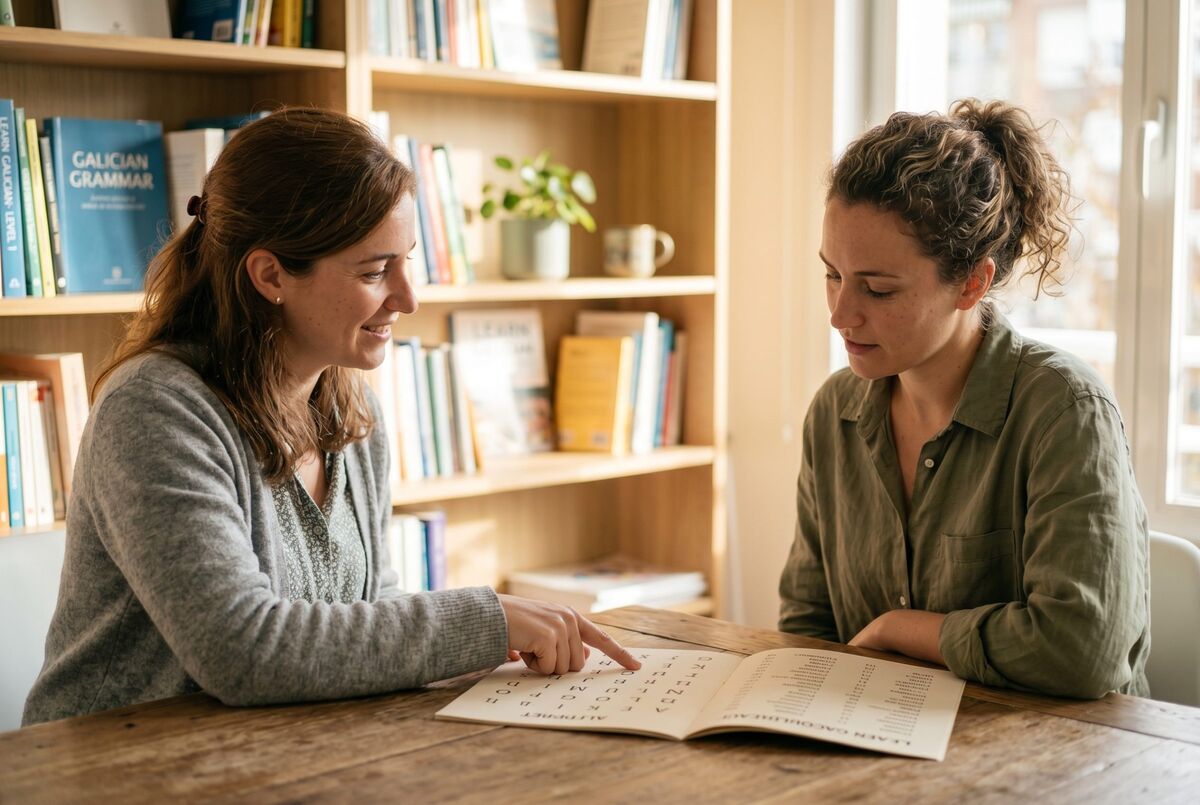
Galician for Beginners tutors for private lessons & classes
Strommen does not place Galician tutors at high volume, because demand is modest and our standards are particular. The students who reach this page tend to be one of three kinds: heritage learners with Galician family roots, pilgrims who fell in love with Galicia on the Camino, or Romance-language learners who want a third Iberian language for completeness. Strommen is a curated practice rather than an open marketplace, so every tutor below was met and vetted by us. The bios are real.
Filter by location, age, or price. Then book a 30-minute free trial.
Below are the Strommen tutors who teach Galician to absolute beginners. Photos, ratings, and rates are real. Click any card to read their bio and book a free 30-minute trial.
I want to learn…
Every tutor, personally met. — founder-vetted since 2006, in Los Angeles and online worldwide.
Get a personalized plan
Pick your language — a language advisor will match you with the right tutor and map out your path.


Profesora de ELE, Pre-school Educator , Online teachers trainer
Your professional guide to speaking Spanish and enjoying the world. 🔵Private lessons 🔵Groups
Personally vetted · Strommen’s note
Ten years teaching Spanish, from SAT Spanish to DELE certification to VIP-level lessons, and Natalia still teaches both private and group, out of Portugal.
Specialties
Profesora de ELE, Pre-school Educator , Online teachers trainer
Your professional guide to speaking Spanish and enjoying the world. 🔵Private lessons 🔵Groups
Specialties
Personally vetted · Strommen’s note
Ten years teaching Spanish, from SAT Spanish to DELE certification to VIP-level lessons, and Natalia still teaches both private and group, out of Portugal.

Primeiro paso — first step
5 things to know about Galician before lesson one
Five honest notes for a beginner approaching the third Iberian language. Save the image. Send it to the friend who keeps asking why anyone would learn this and not just stick with Spanish.
-
01
Bo día, not buenos días
Bo día is the Galician daytime greeting and the small first marker that you are speaking Galician rather than Castilian. Bos días is the plural form ("good mornings," the way Iberian languages often pluralize the greeting). Using this opener in Galicia is the quickest way to be recognized as someone who knows the language is separate.
e.g. Bo día, como está? — "Good day, how are you?" in Galician.
-
02
Closer to Portuguese than to Spanish
Galician and Portuguese descend from the same medieval language and split only in the late Middle Ages. A beginner with even a little Portuguese will find Galician unusually accessible. A beginner with Spanish will recognize most of the vocabulary but will need to retune the pronunciation, particularly the sibilants and the open vowels.
e.g. Galician obrigado and Portuguese obrigado are spelled identically; Spanish gracias is a different word entirely.
-
03
A living language, not a museum piece
Galician was suppressed under Franco and revived after democracy returned to Spain in 1978. It is co-official with Castilian in Galicia, taught in schools, used in regional government and media, and present in everyday life across the region. Speaking Galician today is part of contemporary Galician identity, not a heritage performance.
e.g. Local newspapers like Sermos Galiza and the regional TV channel TVG broadcast entirely in Galician.
-
04
The Camino runs through it
The Camino de Santiago pilgrimage routes converge on Santiago de Compostela in Galicia, and many pilgrims discover the language along the last hundred kilometers. Beginner students often arrive at Galician through the Camino — wanting to thank a hospitalero, understand a sign, or have a real conversation in a village pension. The vocabulary is small and specific and we teach it directly.
e.g. Bo Camiño is the standard greeting between pilgrims walking toward Santiago.
-
05
Two languages, one community, no political position required
Galicians grow up bilingual in Galician and Castilian. Code-switching between the two is normal and unremarkable. Beginners do not need to take any political stance about which language to use when — you learn that by ear over months of conversation. The safe rule for a learner is to use Galician where Galician is spoken and follow your tutor's lead.
e.g. A shop sign in A Coruña might say Aberto in Galician on top and Abierto in Castilian below.
About Galician for Beginners
Galician, the third language of Iberia
A useful first thing to know about Galician is that it is not a dialect of Spanish. It is a separate Romance language, co-official with Castilian Spanish in the autonomous community of Galicia in northwest Spain, with roughly 2.5 million speakers. Linguistically it shares more with Portuguese than with Castilian — Galician and Portuguese descend from the same medieval mother language, Galician-Portuguese, and split into separate but mutually intelligible forms only in the late Middle Ages. A Galician speaker in Santiago de Compostela and a Portuguese speaker in Porto can hold a conversation without switching languages. A Castilian speaker from Madrid can follow Galician but will reach for translation occasionally.
This matters for beginners in a specific way. If you already speak any Spanish, your Galician will sound Spanish-accented at first, and your tutor will gently shape it toward the actual Galician sound — the soft sibilants, the open vowels, the gheada in certain rural varieties. If you already speak any Portuguese, you have most of the grammar already; Galician will arrive almost as a free language. Either way, the cognate floor is generous. Bo día is good morning. Ola is hello. Grazas is thank you. Bos días is good morning plural. Most beginners are reading short Galician texts within the first month, even if they cannot yet produce them.
Why people learn Galician matters for how a beginner curriculum gets shaped. The most common reasons we see are heritage (a parent or grandparent from a Galician village, often a fishing town along the Rías Baixas coast), the Camino de Santiago (the pilgrimage routes converging on Santiago de Compostela cross Galicia and many pilgrims find themselves wanting more than tourist Spanish), academic interest in the Galician-Portuguese medieval lyric tradition, and a small but steady stream of Spanish speakers who realize Galicia has been part of their cultural backdrop their whole life. Your reason shapes the lesson focus.
The political-cultural layer is part of the language. Galician was suppressed under the Franco dictatorship and has been actively revived since the late 1970s as a marker of Galician identity. Speaking Galician in Galicia today is not just communicative — it is a small act of cultural affirmation. Tutors who grew up there will often say so explicitly. Beginners do not need to take any political position; understanding that the language carries this weight helps you read why a small phrase like Bos días can land with surprising warmth in a small Galician town.
The grammar is approachable. Two genders (masculine and feminine), regular verb conjugations with three patterns (-ar, -er, -ir, the same patterns as in Portuguese and Spanish), a familiar tense system, and no exotic structural surprises. The harder corners are the personal infinitive (a feature Galician shares with Portuguese, where the infinitive itself can be conjugated), the soft pronoun system, and the placement of clitic pronouns within verbs in literary registers. We teach the first two within the first six months. The third arrives only if your goals reach into literature.
Our Galician tutors are native speakers, mostly from A Coruña, Vigo, Santiago de Compostela, Lugo, and the Rías Baixas coastal towns. Several are bilingual Galician-Spanish from birth, with one or two who learned Galician formally as adults and remember the climb. The bios on the cards below describe each tutor's region, style, and the specialty within Galician they teach best — coastal versus inland register, literary versus everyday, heritage-focused versus traveler-focused.
What you'll cover
Lessons & classes tailored to Galician for Beginners
Pronunciation first, especially if you already speak Spanish
The biggest early lift for Spanish-speaking learners is retuning the sound. Galician sibilants are softer than Castilian, the vowel system is closer to Portuguese, and the rhythm has its own cadence. We do listening drills with real Galician audio — TVG news clips, songs, regional films — and shadowing exercises so your accent moves toward Galician rather than reading like Castilian with vocabulary swaps.
Survival vocabulary and the cognate floor
Greetings, introductions, asking directions, ordering food (Galician seafood is one of the great unsung cuisines of Europe), basic shopping, family terms, and numbers. If you speak any Spanish or Portuguese, the cognate density makes the first 500 words come fast. We teach the genuinely Galician words — meigo, morriña, choiva, riacho — that you will not get for free from another Iberian language.
Grammar that mostly looks familiar
Two genders, three regular verb conjugations, a familiar tense system. The two features that mark Galician grammatically distinct — the personal infinitive (a conjugatable infinitive shared with Portuguese) and the placement of clitic pronouns — arrive in months three and four. Neither is hard once you see the logic; both are different enough that beginners benefit from explicit instruction rather than trying to deduce them.
Cultural and regional context
Galician is inseparable from Galicia: the Rías Baixas coastline, the Camino de Santiago, the rain-green hills, the cuisine, the regional literature, the morriña (a specific Galician word for the homesickness of someone away from Galicia, used proudly by emigrants worldwide). Beginner lessons include this context, because the language is more interesting and more memorable when its place is part of the lesson. For broader Spanish exposure, our Spanish classes in Los Angeles program complements the Galician track.
FAQ
About Galician for Beginners lessons & classes
Is Galician a dialect of Spanish?
No. Galician is a separate Romance language, co-official with Castilian Spanish in the autonomous community of Galicia in northwest Spain. It descends from medieval Galician-Portuguese and is linguistically closer to Portuguese than to Castilian. The two languages share roots far back in the Iberian Romance family but split into distinct languages by the late Middle Ages.
Will speaking Spanish help me learn Galician?
Yes, substantially. The grammar is similar, much of the vocabulary is cognate, and most Spanish speakers can follow written Galician with reasonable accuracy. The work for a Spanish-speaking learner is mostly in pronunciation (retuning sibilants and vowels) and in the genuinely Galician vocabulary that does not exist in Castilian. Portuguese speakers have an even easier path, because Galician and Portuguese share a closer common ancestor.
How long until I can hold a basic conversation?
Most absolute beginners with no prior Romance-language background reach a self-contained first conversation somewhere in weeks six to ten, at one or two lessons per week. Spanish or Portuguese speakers usually get there faster, often inside a month, because the cognate floor lets vocabulary move quickly. Reading comprehension typically arrives before productive speaking, especially for students who already know another Iberian language.
Why would I learn Galician instead of Spanish or Portuguese?
Three honest reasons we see most often. Heritage: a parent, grandparent, or extended family is from Galicia, and Galician is the language of that family. The Camino de Santiago: pilgrims who fell in love with Galicia and want more than tourist Spanish for the next visit. Linguistic completeness: students who already speak Spanish and Portuguese and want the third Iberian language. Each path shapes the lesson focus differently.
Can I take Galician lessons online or only in person in LA?
Almost entirely online. Galician tutors are not numerous outside Galicia itself, so most students at Strommen study online via Zoom or Jitsi with tutors based in A Coruña, Vigo, or Santiago de Compostela. A few of our Spanish tutors also offer Galician at the beginner level. The booking widget on each tutor's profile shows their available formats.
Is Galician useful outside Galicia?
Within Galicia, essential for full participation. Outside Galicia, useful in specific contexts: Galician diaspora communities in Argentina, Cuba, Uruguay, Switzerland, and parts of the US still use the language at home and in community organizations. The 19th- and early-20th-century Galician emigration to Latin America was so large that Galician-Spanish vocabulary influenced regional Spanish in the Río de la Plata area. Outside those contexts, Galician is more a heritage and cultural language than a practical second language.
What does a Galician beginner lesson look like?
A typical hour mixes a short Galician-only warm-up, 20 to 25 minutes of new vocabulary and grammar in a small everyday scenario, 15 minutes of paired conversation practice, and a short reading or listening piece (often from TVG, the regional broadcaster, or from Galician folk songs and contemporary music). Homework runs 20 to 40 minutes between lessons. Each tutor's bio describes their specific style.
Ready for Galician for Beginners lessons or classes?
Book a free 30-minute trial with one of our personally vetted tutors. Private lessons or small-group classes — your choice.